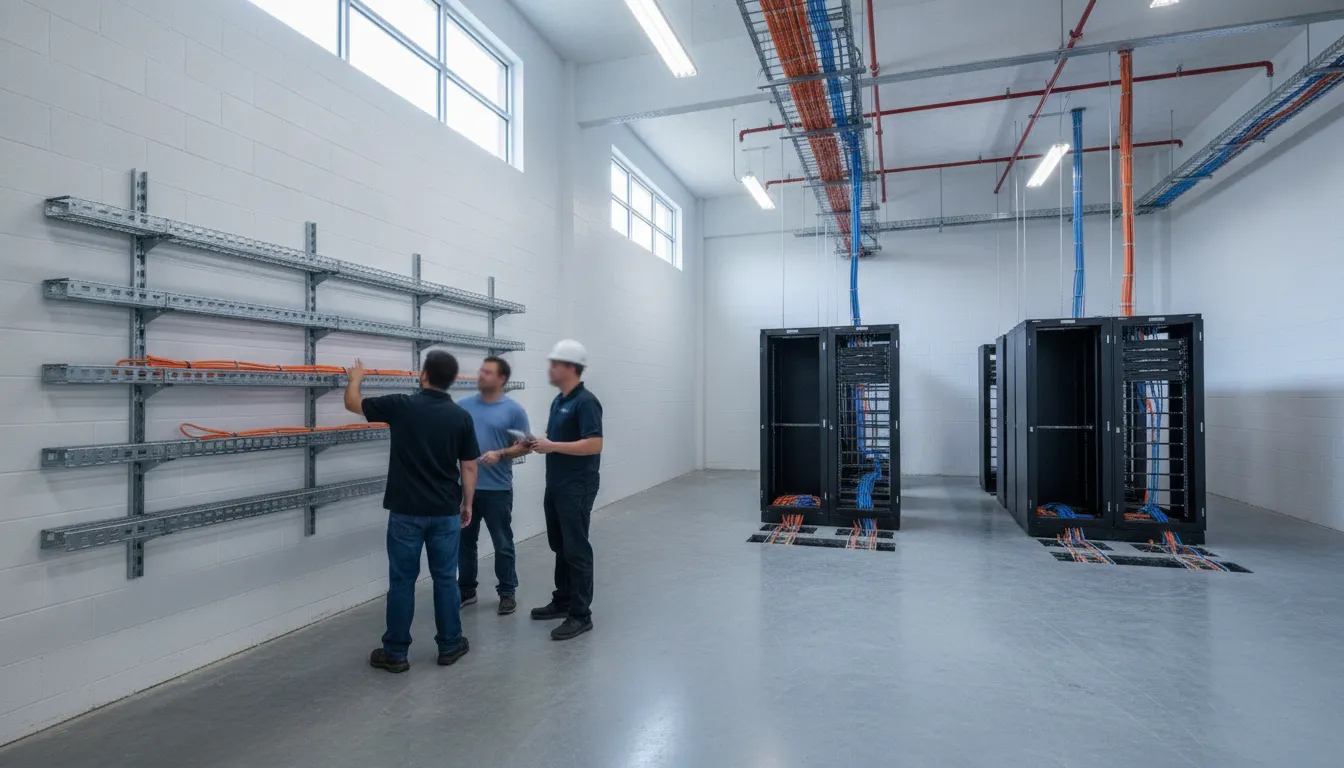
Choosing a commercial network cabling contractor is about project fit, not just a crew that can pull cable. The right partner fits the building, the schedule, the technology plan, and the people who will operate the result. A good fit is visible before installation starts. The contractor asks useful questions, identifies conditions that can change the scope, and explains how the finished work will be tested and documented.
What a commercial network cabling contractor should evaluate first
Commercial cabling is infrastructure work. It may support workstations, wireless access points, phones, cameras, access control, audiovisual systems, building controls, or other connected devices. The right contractor begins by understanding those uses rather than treating every project as a repeatable cable-pulling exercise.
Before comparing proposals, assemble the information a contractor will need to judge project fit:
Facility type and occupancy: office, school, healthcare environment, industrial site, government facility, warehouse, data center, or another operating setting.
Current conditions: existing racks, equipment rooms, pathways, ceilings, conduit, cable trays, power, and cabling that may remain in service.
Connected systems: user devices, wireless, voice, cameras, access control, professional AV, or other systems that depend on the network.
Project constraints: phasing, occupied spaces, restricted areas, shutdown windows, construction sequencing, site access, and coordination with other trades.
Future needs: planned moves, new rooms, additional devices, expansion areas, or the need to preserve usable pathway and rack capacity.
A contractor should be able to say what it can evaluate directly. It should also name the information it needs from the owner or other trades, and which assumptions must be confirmed during a site review. That clarity is more useful than a broad promise to handle every type of technology.
How to compare commercial network cabling contractor experience
Relevant experience is not just a list of industries or a gallery of finished installations. Ask for examples that resemble the conditions your team must manage. Similarity may involve the facility, the cable routes, the number of locations, the operating hours, the connected systems, or the handoff requirements.
Look for comparable project conditions
For a school or healthcare facility, protecting daily operations may matter as much as the cable pathway. Coordinating access to occupied areas can shape the schedule just as much. For an industrial or oil-and-gas environment, the contractor may need to work around active operations, restricted zones, and long runs between network spaces. For a data center, rack layout, fiber pathways, labeling, testing, and closeout records can become central to the project. For a government facility, site access and documentation requirements may shape the schedule.
Ask the contractor to describe its role on comparable work. Did it assess existing conditions and coordinate the design? Did it install pathways and cabling, connect related systems, test links, and document the result? Did it train or brief the operations team? The answer helps separate experience with the full project lifecycle from experience with only one task.
Ask about copper, fiber, and connected systems
A project may include copper horizontal runs, fiber backbones, and equipment-room organization. It may also include wireless infrastructure, cameras, access readers, voice, or AV. You do not need to assume that one provider must perform every specialty. You do need to know how the proposed cabling scope will coordinate with the systems that depend on it.
Ask where the contractor's responsibility begins and ends. Confirm who supplies network electronics, who configures devices, who coordinates power or pathway work, and who owns final acceptance. Clear boundaries reduce the chance that a missing handoff becomes an operational problem later.
What to ask a commercial network cabling contractor during planning
The planning conversation should turn a general request into a scope that can be reviewed. A capable contractor will ask about more than the number of outlets or the preferred cable type.
1. How will you review the facility?
Ask whether the team will walk the relevant spaces, inspect existing network rooms, identify pathway conditions, and document locations that can affect installation. Important observations may include ceiling access, wall construction, conduit capacity, cable-tray routes, equipment-room space, fire or security boundaries, and areas that cannot be interrupted.
The point of a site review is not to promise that every condition can be predicted. It is to expose the conditions that need a decision before the work is scheduled.
2. How will you translate needs into a cabling plan?
Ask how the contractor will map current devices and reasonable expansion needs to outlets, pathways, racks, and network rooms. The plan should identify assumptions and open questions instead of hiding them inside a proposal. It should also show how the cabling scope coordinates with wireless, cameras, access control, voice, or AV. That coordination matters when those systems are part of the facility plan.
3. How will the work be phased?
In an occupied facility, the installation sequence may matter as much as the final cable count. Ask how the contractor will stage work, protect active areas, coordinate access, communicate interruptions, and handle work that depends on another trade. If several buildings or floors are involved, ask whether the same process and documentation will be used at each location.
4. What happens when field conditions differ?
Use the same four questions in this order when you compare proposals:
Confirm the site review and the conditions it will cover.
Confirm how needs become outlets, pathways, racks, and room plans.
Confirm how occupied areas and other trades will be phased.
Confirm how field discoveries and owner approvals will be recorded.
Existing buildings rarely match an old drawing perfectly. Ask how discoveries are documented, who reviews scope changes, and how the contractor separates a necessary field adjustment from an optional improvement. A clear change process gives the owner a chance to approve a revised plan instead of discovering the difference at closeout.
When proposals arrive, compare what each one actually includes. A lower or higher number by itself does not show whether two contractors are offering the same work. Use a simple scope comparison such as this:
Project area
Questions to compare
Why it matters
Discovery and design
Is there a site review, an existing-condition assessment, and a stated set of assumptions?
Unstated conditions can create confusion during installation.
Pathways and rooms
Are racks, rooms, trays, conduit, penetrations, and access requirements identified?
Cabling cannot be planned independently from the route it must follow.
Installation scope
Are cable types, destinations, labeling, termination, cleanup, and protection described?
Specific scope makes bids easier to compare and handoffs easier to manage.
Coordination
Does the plan address active operations, other trades, security, wireless, AV, or device installation?
Connected systems often share pathways, rooms, schedules, and dependencies.
Testing and closeout
What testing, labeling records, drawings, photographs, and final documentation will be delivered?
Operations teams need a usable record of what was installed and accepted.
Support and handoff
Who answers questions after turnover, and what training or troubleshooting path is included?
A clear handoff helps the owner use the infrastructure after the crew leaves.
Do not treat a table like this as a substitute for the project documents. Use it to find gaps and ask follow-up questions before selecting a contractor.
When cabling scope overlaps with network and facility planning
A cabling decision can affect more than the cable route. The location of equipment rooms influences cable distance, pathway access, rack organization, and the way technicians reach the infrastructure later. The location of wireless access points depends on the building and the intended coverage plan. Cameras, access readers, phones, displays, and other devices may share pathways or place different demands on the network.
That does not mean a cabling contractor should design every system without input from the owner or the other specialists involved. It means the contractor should identify dependencies early. Ask who will confirm device locations, who will provide network requirements, and who will approve changes to rooms, pathways, or outlet locations. If the project includes an existing network, ask whether the proposed work must coordinate with current equipment, maintenance windows, or an internal IT team.
For a facility that is changing significantly, a coordinated review can also help sequence decisions. The team may need to confirm pathways before final device locations. It may also need to confirm room capacity before ordering equipment, and confirm the handoff record before closing ceilings or walls. A contractor that explains these relationships gives the owner a more useful basis for approving the work.
Testing, labeling, and documentation are part of project fit
A cabling installation is not complete simply because the cable is in the ceiling. A single link coming up once is not the whole acceptance process either. The acceptance process should be defined in the project scope. Ask what will be tested and what counts as an acceptable result. Ask how failed links will be handled, and how the records will be tied to cable identifiers or locations.
Documentation should be practical for the people who maintain the facility. Depending on the project, a useful closeout package may include cable labels, outlet or port maps, and rack or room information. It may also include pathway notes, test records, photographs, and a list of unresolved items. The exact deliverables should match the project and be agreed before work begins.
Also ask how changes made in the field will be reflected in the closeout record. A drawing that shows the original plan but not the installed route creates work for the next technician. A project-fit contractor treats the documentation as part of the installation, not as an afterthought.
When an integrated contractor is a better fit
Some organizations want a cabling-only installer. Others are coordinating cabling with security, networking, cybersecurity, AV, or ongoing technology support. Neither choice is automatically right. The decision depends on the owner's internal team and the number of vendors already involved. It also depends on how closely the systems share pathways, rooms, schedules, and acceptance criteria.
An integrated provider can be useful when the project requires coordination across several facility technologies. For example, a wireless expansion may depend on cabling routes and switch capacity. A camera or access-control deployment may depend on network connections, equipment-room organization, and a clear division of configuration responsibilities. A conference-room project may need AV, network, and room coordination at the same time.
FastString describes its work as coordinating access control, video surveillance, structured cabling and fiber, networking, cybersecurity, and professional AV when those services fit the project. Review the capabilities page to see the service areas. Then use the project process to understand the assess, plan, deploy, commission, and manage framework. The relevant scope should still be confirmed for your specific site.
Questions to ask before selecting a commercial network cabling contractor
Have you worked in a facility with similar occupancy, access, and operating constraints?
Who will inspect the existing rooms and pathways before the scope is finalized?
How will you coordinate with the network, security, AV, electrical, and construction teams?
Which parts of the work are included, and which parts belong to another provider or the owner?
What assumptions could change the installation plan?
How will you handle field discoveries and owner-approved changes?
What testing and closeout records will be delivered?
Who will explain the completed installation to the team that operates it?
What support route should the owner use for a question after handoff?
Strong answers should be specific enough to help you make a decision. They should not pretend that the contractor can know every field condition before seeing the site.
How to decide whether the project is a good fit
The strongest fit is the one whose planning process matches the complexity of the work. The scope also has to be clear enough for the owner to approve. Before moving forward, confirm that you understand the site assumptions, the installation boundaries, and the coordination plan. Confirm the acceptance process and the handoff records as well.
If your facility is in the Houston area, FastString Professional Services can review the environment, technology needs, and budget. The client then approves a tailored plan. A project manager can help identify whether the required scope is primarily cabling. The same review can show whether the work needs coordination with network infrastructure, security, AV, or other systems.
What should a commercial network cabling contractor review before bidding?
Ask for a review of the rooms, pathways, existing cable that will stay, and the systems the new work must support. The contractor should also name occupied areas, access limits, and assumptions that still need a site visit. A bid that skips those items is harder to compare with one that states them.
How is contractor fit different from choosing a cable category?
Cable category, fiber type, and test method belong in the cabling design. Contractor fit is about who will assess the site, write the scope, install the pathways, test the links, and hand over records the operations team can use. You can choose a cable type and still pick the wrong partner if those responsibilities are unclear.
When should cabling be coordinated with security, network, or AV work?
Coordinate early when cameras, access readers, wireless access points, phones, or conference rooms share pathways, rooms, or acceptance dates. The cabling contractor does not have to configure every device. It does need a clear handoff with the people who will. That split should be written before work is scheduled.
What closeout records show that the project is actually finished?
Look for labels, test records, and a map or list that ties cables to rooms, racks, and outlets. Photographs and a short list of open items help when the building is still changing. The exact package should be agreed in the scope, not invented at the end of the job.
Have a question this guide didn’t answer?
Talk it through with a FastString specialist. Call 713.861.6100 or send your project details.